A few seconds can change everything.
Android's earthquake warnings, on any device.
Canarito runs on your computer and sends earthquake warnings to your iPhone, your computer or anything else you choose. Free and open source.
Not official, and it can fail. Read what can go wrong.
10:24
ntfy.sh · now
How it works
Google picks who gets an alert by the location each device reports. An Android emulator with a fixed location is enough.
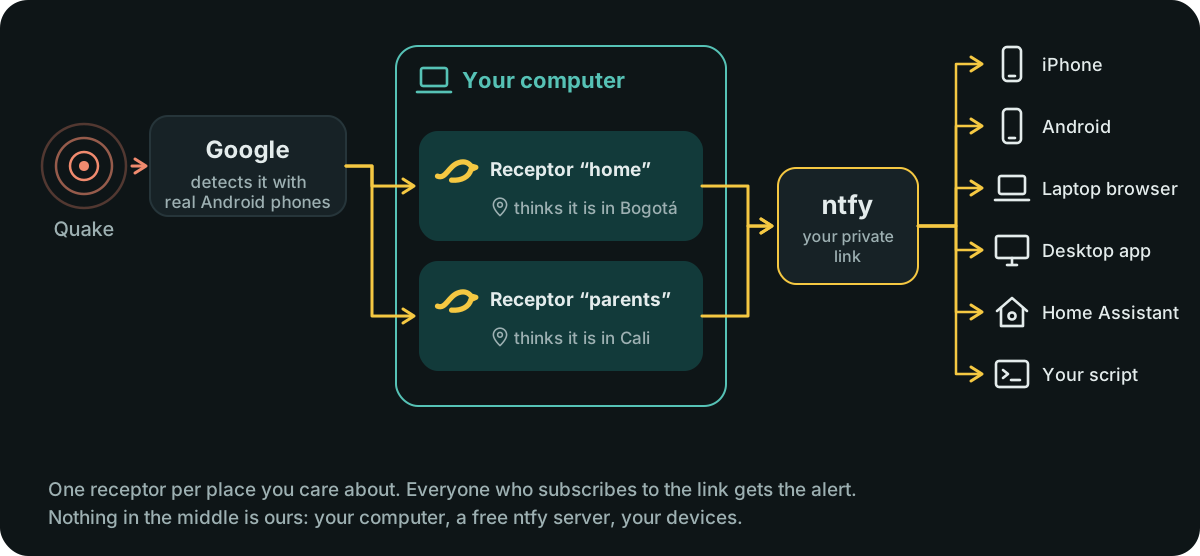
Tested with real quakes. In September 2026, two quakes in Colombia reached our emulators. The ones inside the alert radius got the warning; the ones 478 km away did not.
No server. The emulator runs on your computer, and ntfy, a free service, carries the alert to your devices. If you want everything under your control, run your own ntfy.
Connect anything
Canarito sends every alert to a private ntfy link. Anything subscribed to that link gets it.
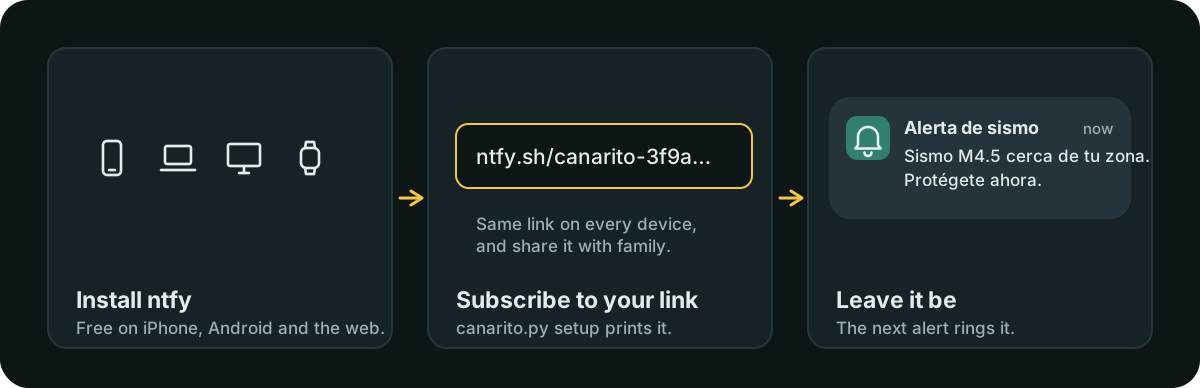
Phone and computer. The ntfy app on iPhone and Android, or ntfy.sh/app in any browser.
Something louder. A siren, a speaker or a light through Home Assistant, or your own script. On iPhone, ntfy cannot ring through silent mode: Apple keeps that for official alert apps.
It follows you
A receptor can follow one person's phone instead of staying at a place. The OwnTracks app tells your computer where you are, and Canarito moves the receptor with you.
No wasted memory. When you get home, your receptor sleeps and the home receptor alerts you too. When you leave, it wakes up wherever you are. Positions are rounded to 1 km.
One computer for the whole family. One fixed receptor for home and one following receptor per person who travels, about 4 GB of memory each. A 16 GB computer fits home and two people away at the same time.
How much warning you get
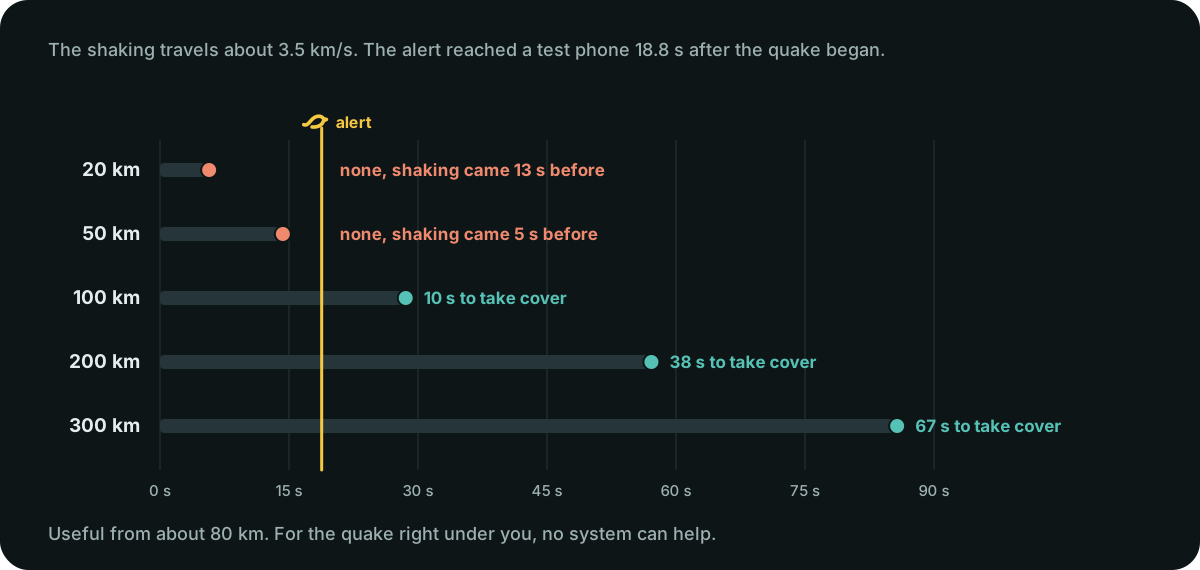
It depends on how far you are from the epicenter. Google says only 36% of its own users get the alert before the shaking.
What can go wrong
Read this before you trust Canarito with anything important. Canarito tells you on a separate link when something breaks, and when a nearby quake reached no alert.
The emulator license covers app development only, and Google's data may not be redistributed without permission. Running this is your decision.
Its anti-abuse system reads the emulator's sensors. It did not block alerts in our tests, and nobody will tell you if that changes.
An emulator with a location about 25 hours old missed an alert. Canarito reboots it every 18 hours, and each reboot leaves about 10 minutes without coverage.
One in eight new emulators never registered. After 90 minutes Canarito tells you on the admin link so you can create it again.
It moves at most every 5 minutes and Google takes a few minutes more, so the first minutes after a long trip can be uncovered. If OwnTracks stops sending, it stays at the last known place; after 6 hours without a position we tell you.
A retry can send the same alert twice. We chose twice over never.
Anyone who knows an ntfy.sh topic name can read it. Canarito picks a random name: keep it within your family.
If the computer suspends, the receptor stops. When it wakes, Canarito tells you how long it had no coverage. Turn off sleep on that machine.
Start
You need macOS or Linux, Python 3.9, Java 17 and the Android command line tools.
git clone https://github.com/sebospc/canarito.git && cd canarito
echo "sdk.dir=$ANDROID_HOME" > local.properties
./gradlew :android:assembleDebug                                  # the app that goes inside the emulator
python3 canarito.py setup --name home --lat 4.711 --lon -74.072   # your place, from any map
python3 canarito.py run --name home                               # leave it running
The first time, Google's earthquake service takes 15 to 60 minutes to start inside the emulator. Wait for the line AEA registered. Full instructions are on GitHub.